Cornerstone Workforce AI:
Intelligence and Action in the Same Box
YSK: Kyle & Co has an active advisory relationship with Cornerstone OnDemand. This piece was produced under Kyle's independent byline as part of that engagement. Independence is the asset we bring to every client relationship.
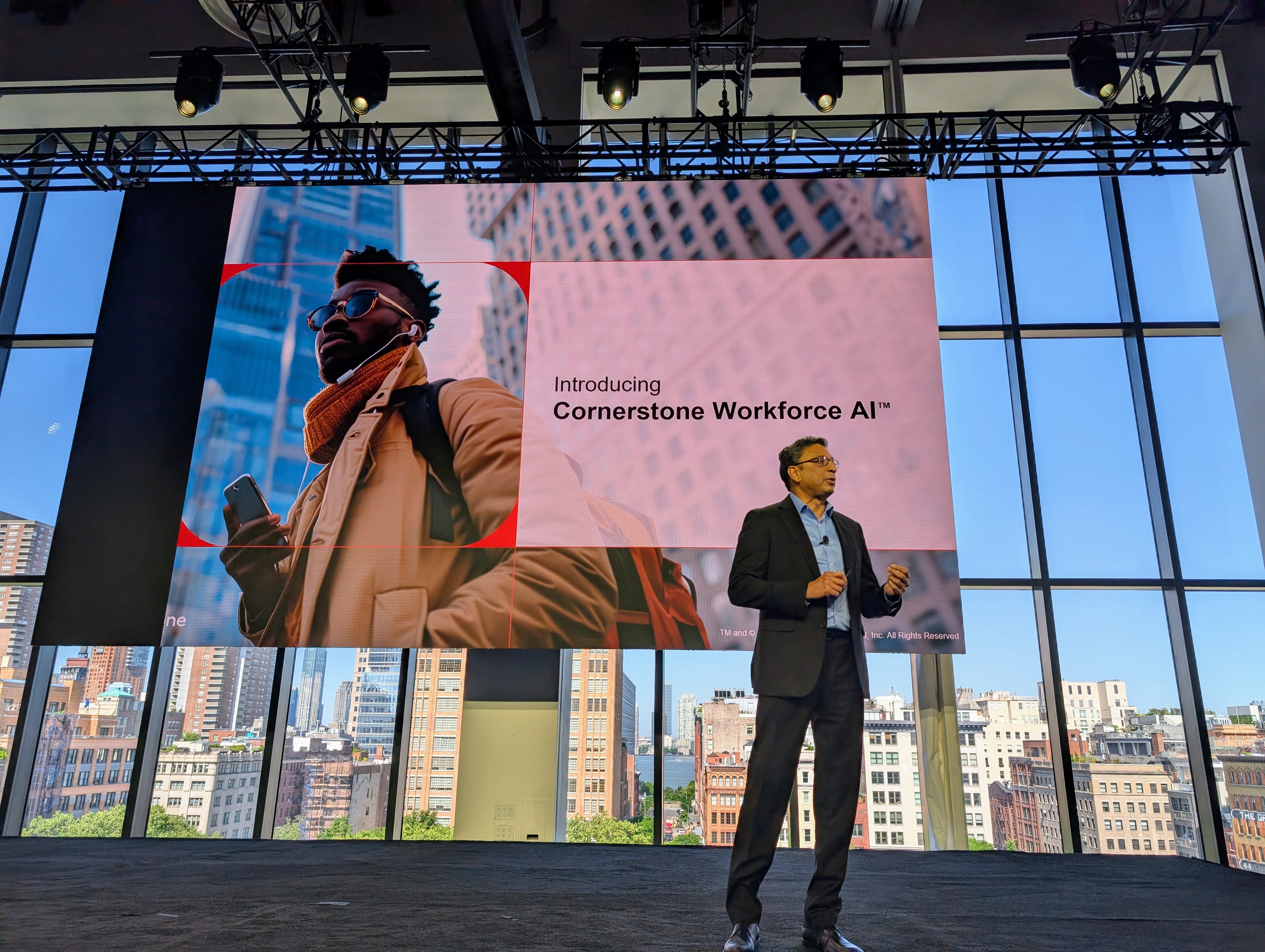
Kyle & Co recently attended Cornerstone OnDemand's analyst day and Connect event in Soho with an invitation to publish an honest, independent assessment of their newly launched Workforce AI.
Cornerstone's CEO, Himanshu Palsule, called it an inflection point for the company. It was clearly a big moment—one that stands out among many other big announcements made this Spring.
But announcements are easy and meaningful innovation is hard. Here are my big takeaways:
First, Workforce AI is the most competitive answer Cornerstone has built in years to the major and minor players that have been pressing them on every flank—SAP SuccessFactors, Workday, Eightfold, and more—and the most credible answer the HR technology market has produced to the structural weakness of the pure-play talent intelligence category.
Second, if you are a Cornerstone customer, the headline is simple. The platform you bought is becoming meaningfully more powerful. The pricing model is shifting in your favor in ways most of the market isn't matching. And the underlying competitive position is stronger than it was a year ago. All of that is real.
And keeping it real: The launch narrative didn't fully answer two major questions Cornerstone's customers—and the broader market—need answered to truly grasp the full value Workforce AI is promising.
So let's take it all into account. The big picture, the big opportunity, and the work that still has to happen to make it pay off. To frame things up, I have two questions and a lot of thoughts.
Question One: What Problem is Workforce AI
Actually Solving?
I'll be honest: It took a minute to fully grasp what Cornerstone was actually launching. Matter of fact, every major HCM and talent technology provider is pushing some version of orchestration layered with agentic AI.
Cornerstone's framing for Workforce AI—"the intelligence platform for workforce readiness, delivering the insights leaders want, the skills people need, and AI agents that make action easy"—didn't really explain what it's solving for. As they demonstrated Workforce AI being used to build skills capabilities, and an executive checking employee engagement on the drive to work, I kept asking myself, "Where's the inflection point?"
What was sitting underneath the launch narrative never quite made it onto the main stage—and it's also what is most compelling about Cornerstone's big move.
The real reason Workforce AI is such a massive innovation and competitive move has less to do with the product line—and everything to do with the hierarchy of impact this platform is positioned to unlock.
At the business level, Workforce AI is a story about workforce resilience and adaptability at enterprise scale—the ability to redeploy capability against shifting strategy without months of org redesign, to surface internal talent before posting external roles, to make workforce decisions on the same cadence as financial ones. And Cornerstone—with decades of experience pioneering talent and learning for some of the world's most innovative companies—has the data to unlock this story with Workforce AI.
And though they didn't say it on stage, this is absolutely at the core of the ambition for this move. I was lucky enough to sit down with Himanshu and his new Chief of Staff Nicole Williams after the launch preview and he said it plainly: "Our data is our greatest moat."
But it's more than just data—which is something lots of HCM companies are sitting on. It's what data they have and where this data can be utilized… and that's where this gets spicy.
At the HR function level, this should be a story about the intelligence and AI layer being made available inside the tools and workflows HR already uses (performance, succession, recruiting, learning) rather than as a separate analytics destination HR has to maintain alongside everything else.
Cornerstone has the application footprint to tell that story. And my hot take is that, at the ecosystem level, this is the most interesting story they didn't tell—and the one that connects Workforce AI to a structural problem the industry has been circling for years.
Talent intelligence vendors—Visier, Lightcast, Revelio, Horsefly, TalentNeuron—built powerful platforms. They remain incredible systems of insight… but they're sitting alongside the systems of action where work actually gets done.
In my experience, insight that isn't actionable becomes a novelty. And that's a problem for intelligence players in HCM.
This category has been quietly trying to escape that fate by rebranding from analytics to intelligence and pivoting toward strategic workforce planning use cases, but the receipts are showing: Slowing growth, retention pressure, and more than a little churn in several C-suites.
My analysis here: Cornerstone's implicit bet is that the way out of that trap is to put the intelligence layer and the action layer in the same box. That is a real thesis—and it's the one the launch should have led with in my humble opinion.
Question Two: What Do Customers Need To Understand
To Actually Get The Outcomes?
One thing that stood out to me from Cornerstone's analyst day (the day before the Connect event) came from their new Chief AI Officer, Guna Jayaraman—interestingly a former HR technology leader at Amazon.
When responding to our probes about how Workforce AI works, he posited that their customer doesn't need to worry about how everything works under the hood—that this new AI and orchestration layer is designed in such a way that HR leaders can point it at problems and get better outcomes.
It's a nice idea, but it ignores one of the biggest risks (and, potentially, the biggest opportunities) that this wave of innovation poses for HR. I wrote in my notes at the time, "Yes, CSOD customers very much do need to know—so they can reliably get inflection-level outcomes from it."
I want to come back to what customers need to know, because it matters more than it might sound on first read—and the reason it matters has everything to do with how Cornerstone is choosing to make money on Workforce AI. But first, some context.
Most AI HR vendors right now are pricing on consumption: per token, per API call, per agent action. Under that model, the vendor gets paid whether or not the customer figures out how to extract value. Customer maturity is the customer's problem. Confusion, in fact, is a revenue line.
Cornerstone has voluntarily given that up. Workforce AI is priced in bundles tied to outcomes—Learn+, Elevate+, Intelligence+, Accelerate+—with no token charges and no API fees.
CMO Mini Peiris said it plainly from the stage, "We are the only ones who are tackling outcome-based pricing." And… having attended almost every major AI launch in HCM this season, I can say this seems to be true.
That posture is the single boldest commitment to value over consumption that any major HR technology vendor has made this year, and it deserves more credit than it has gotten in the post-launch coverage.
It also raises the stakes on the question Cornerstone didn't answer.
Under consumption pricing, customer ignorance is revenue. Under outcome-based pricing, customer ignorance is churn.
Which means what the customer needs to know in order to deploy responsibly and extract value is no longer an interesting question. It is existential—to the renewal, to the upgrade path, and to the entire premise of the pricing model Cornerstone has just bet the company on.
So what do customers need to know?
Honestly, the market is still working that out, and that's part of the strategic opportunity here. The vendor who defines operator-level understanding of agentic workforce systems—what to ask, what to govern, what to staff for, what to measure—gets to set the terms of the category. The vendor who doesn't will be defined by whatever framework someone else applies to them. Two pieces of that operator understanding are already non-negotiable.
The first is Capability Literacy.
What People Graph (a core engine within Cornerstone Workforce AI) actually does with the signals it captures, where inference happens, where human judgment stays in the loop, and what kinds of outcomes the agents are and aren't designed to produce. Without this, customers under-deploy out of caution or over-deploy out of enthusiasm.
Both are bad for outcomes.
The second is Governance Literacy, and this is where the stakes get sharp.
One aspect of the Workforce AI architecture—specifically, skill inference from work—echoes the architecture sitting at the center of the pending Eightfold AI class action lawsuit.
The architecture Cornerstone is putting in front of HR organizations—signal capture from collaboration tools, skill inference from work, agentic action across talent processes, People Graph aggregating all of it—brings with it some real and serious governance questions that HR leaders are already grappling with (and to varying degrees of success).
Cornerstone has acknowledged those questions, but acknowledgment isn't enablement—and HR is looking to their partners for answers.
The deeper governance work—what to disclose to employees, what to gate behind consent, how to audit inference outputs, where to draw the line between insight and surveillance—is exactly the work where many HR organizations are already getting bogged down.
And under outcome-based pricing, governance uncertainty becomes a commercial problem, not just an operational one.
A customer who has paid for Intelligence+ or Accelerate+ but who is uncertain about the governance implications will restrict the deployment—gating capabilities, narrowing the signal sources, limiting the agents they actually turn on. How long will they keep paying for capabilities they aren't fully deploying when the outcomes that justify the package they bought will not materialize.
The gap between what they bought and what they can actually operate will show up at renewal as buyer's remorse—a point of contention that talent technology providers have always had to navigate… but which carries massive implications for Workforce AI.
Which means Cornerstone has a direct commercial stake in helping the market mature on questions it has so far chosen not to lead on. Governance literacy isn't a side conversation. It's part of how the pricing model survives contact with reality.
Cornerstone has acknowledged the gap implicitly through its forward-deployed engineering motion. FDEs are a credible bridge between vendor capability and customer readiness for early Workforce AI deployments—and they are also a tell that the bridge has to be built case by case for now. FDEs do not scale to 7,000 customers.
So the rest of the bridge has to live in customer training and enablement, in partner enablement, through overhauled customer success operating models, and (selfishly) via deeper partnerships across the analyst and influencer ecosystem. None of that was visible at the launch.
Why The Unanswered Questions
Matter
Here is where Cornerstone's bigger AI story actually lives.
Workforce AI is not just an AI upgrade. It is the competitive weapon Cornerstone has needed to defend and extend the talent suite against vendors who have been outpacing them in non-learning modules for years.
People Graph and Skills Engine will undoubtedly make Cornerstone Learn meaningfully harder to displace. They may make Cornerstone's performance, succession, recruiting, and mobility modules harder to displace—if and only if those modules can now compete on outcomes that competitors like SuccessFactors and Workday can't match. That is the test.
MCP and the headless architecture are part of how Cornerstone widens that moat by extending the platform's reach and accessibility across whatever enterprise AI stack the customer's CIO has standardized on, and pulling Cornerstone's data and capability into the systems of action that matter.
That's a smart structural move, even if it isn't unique to Cornerstone for long; SuccessFactors and Workday are building toward similar capability. Cornerstone is ahead today. Whether they stay ahead is the question.
And it is the same question that runs through both of the unanswered ones above. The competitive thesis is real. The pricing posture is bold. The architecture is credible… But the buyer who can operate this platform at the level it's designed for is rare. And outcome-based pricing means Cornerstone only wins when those buyers exist in volume.
To me, all of this means Cornerstone's most important product isn't Workforce AI itself. It's the customer literacy that lets Workforce AI deliver on what the launch promised. And I didn't hear much about how Cornerstone (or its competitors, frankly) is accounting for this.
What We'll
Be Watching
Cornerstone's Workforce AI launch was undoubtedly a beginning rather than a destination. Three things will determine whether Workforce AI earns the inflection-point framing Himanshu put on it:
- Whether Cornerstone closes the product-to-problem gap on what business, HR, and ecosystem problems Workforce AI actually solves—with named outcomes, named customers, and named numbers.
- Whether Cornerstone builds the literacy infrastructure—capability and governance—that their outcome-based pricing model now depends on.
- And whether the non-learning modules prove they can compete on those outcomes with the new intelligence layer underneath them.
Cornerstone has embarked on a new journey—of that I have no doubt. They have built a credible, ambitious, architecturally honest platform with a pricing posture that respects their customers more than the market norm. Though the story they started with at Connect in NYC didn't quite earn the inflection-point claim, they have 16 more cities to go before they're done—and I expect this story underneath it all will continue to push through to the surface.
We'll be watching.
Navigating workforce AI
requires more than a vendor briefing.
The Human-Centric AI Council brings together senior HR leaders to work through exactly these questions — together, without the vendor spin.