
I’ve been covering innovation cycles in talent strategy and HR technology for over a decade. I am being totally literal when I say I’ve never seen things move as fast as they are moving now.
Take AI interviewers, for example.
In the span of about 18 months, they went from fringe experiments to one of the most talked-about categories in talent acquisition. New vendors emerged almost overnight. Established players announced the addition of AI interviewer capabilities to their product suites. Buyers suddenly found themselves fielding demos that promised faster screening, better signal, more fairness, and less recruiter burnout—all at once.
And yet, despite the momentum (or maybe because of it?), something felt off.
For all the noise in the market surrounding these types of solutions, signals of impact at scale were limited to vendor-published ROI metrics. Definitions of what AI interviewers are varied widely. Capabilities blur together with other solution sets.
Most buyer conversations still orbit the same (ultimately useless) question: “Who has the best AI Interviewer?”
And because we have more stories of AI pilots on pause than we do of them advancing into actual solutions, the team at Kyle & Co decided to take the opportunity to dig in here—and flip this myopic, oversimplified, useless question on its head.
Over the last three months, we evaluated twelve of the leading AI Interviewers in the market to better understand what, exactly, is going on in this corner of the market:
- We defined what AI interviewers actually are (and aren’t)
- We built an RFI to evaluate the market
- We benchmarked standard vs. differentiated offerings
- We built a new model for market analysis—the Category Compass—and I’m excited to share more about it
Here’s our list of participating vendors:
And would you believe there are still others we didn’t include—for no reason other than we couldn’t take on the entire category all at once.
TL;DR: AI interviewers are moving faster than the market can define or evaluate them. “Who’s best?” is the wrong question. We evaluated 12 vendors, built a benchmark, and created the Category Compass to help talent leaders get oriented—so they can find the right-fit solution for their use case and deploy it responsibly.
Worst Question You Can Ask: Why “Who’s the Best?” Keeps Failing
AI interviewers are not a monolith. They show up at different moments in the hiring process, solve different problems, and place very different demands on recruiters, candidates, hiring managers, and underlying infrastructure. Vendors aren’t all building modded versions of the same thing—they’re building different solutions to different problems.
- Some are designed for high-volume, hourly hiring
- Others focus on structured behavioral screening.
- Some prioritize signal quality and consistency.
- Others optimize for throughput, speed, or cost.
Trying to crown a single “best” solution flattens all of that nuance, and it almost guarantees disappointment during implementation.
This is also a category where the stakes are unusually high. As we write in our upcoming research, this is perhaps the most sensitive application of AI we’ve seen in talent acquisition so far—not because the tools are inherently flawed, but because the stakes are high and the margin for process immaturity is low.
AI interviewers promise consistency and scale—but hiring still requires judgment and context. That tension is exactly where most evaluations fall apart: teams want to move quickly, but they’re being asked to make decisions about solutions that touch candidate experience, defensibility, governance, and workflow—all at once.
What buyers actually need isn’t a winner. They actually need orientation, a Compass. Get it??
A Case for a Compass: The Real Challenges in the AI Interviewer Market
AI interviewers are hard to evaluate not because they lack promise—but because the category itself is still taking shape. In our work, three challenges surfaced immediately:
- This is a fast-emerging, rapidly-evolving category: Capabilities are changing faster than buying cycles. What’s considered table stakes today was a meaningful differentiator six months ago. Roadmaps are fluid, positioning is shifting, and even vendors are still defining what they want to be.
- There is lots of promise, but limited proof at scale: Pilots of AI interviewers abound. Company-wide rollouts are far rarer—and often stall due to change management friction, governance concerns, or misalignment with existing workflows. The gap between “interesting demo” and “durable value” is still wide.
- There’s no shared market definition: “AI Interviewer” can mean very different things, including:
- An autonomous screening agent
- A structured interview assistant
- A candidate engagement layer
- A decision-support tool
Sometimes a solution has all four. Sometimes it’s nothing more than a process automation bot vibe coded by an out-of-work recruiter. The problem is… all of them demo pretty damn well these days. Without a shared definition, buyers are left to connect the dots themselves—often while the workload they’re managing with a skeleton crew piles up.
And this is where traditional market frameworks start to break down: Rankings require maturity. Quadrants imply stability. But AI interviewers are neither static nor settled.
So we decided to evaluate them differently—as though we were consulting a client on which one would work best for them.
Getting Our Bearings: The Work Behind the Model
Before we could build a model to help practitioners navigate the category, we had to do the unglamorous work that the market tends to skip: define boundaries, establish a baseline, and separate demonstrated capability from marketing claims.
To do that, we:
- Collected structured RFI responses across five capability areas including
- Candidate Experience
- Recruiting & Hiring Team Experience
- Measurement & Insights
- AI Model & Capabilities
- Implementation & Integration)
- Ran live product briefings and demos with each vendor (18 hours of briefings and demos and counting!)
- Benchmarked what “limited,” “standard,” and “robust” look like based on observable evidence
- Validated key facts with vendors to ensure accuracy and fairness
Along the way, the team realized just why this work to build a better model for market evaluation matters: In categories moving this fast, the biggest risk isn’t that solutions lack one feature or another—it’s that many buyers don’t know how to effectively evaluate beyond the features when they’re looking at something wholly new.
Too many teams decide based on vendor-led demos, unverified ROI stories, or a patchwork of internal opinions that never resolve into shared criteria.
Our approach reflects a core belief behind the research: rushed adoption introduces risk, and guardrails without grounding stall adoption. Understanding where solutions fall on that spectrum is more useful than assigning a single abstract score.
Introducing the Category Compass: Getting Your Bearings in a Confusing Market
This is the gap the Category Compass was designed to fill.
The Category Compass is a Kyle & Co research framework built to bring structure to fast-moving, ambiguous technology categories before they are ready for rankings.
It is not a “best of” list based on Ivory Tower ideas
It is not an oversimplification of the market into two abstract axes
And it is not a designation of leaders and laggards
Instead, it’s built to surface patterns, ground the conversation in evidence, and create clarity in crowded markets—especially when the category is emerging, uneven, and evolving quickly.
At its core, the Category Compass helps answer a different set of questions than traditional market assessments:
- What capabilities are widely available today, and which are still unevenly delivered?
- Where does sophistication create leverage, and where does it introduce unknown risks?
- How much organizational maturity is required to deploy certain capabilities responsibly?
- What factors should buyers understand before they pilot or scale?
More to the point: Product-to-use-case fit matters more than product positioning. It… always has, but especially within the AI Interviewer category.
What looks advanced or differentiated in one hiring context may be impractical (or even nonviable) in another.
The Kyle & Co Category Compass: A Visual
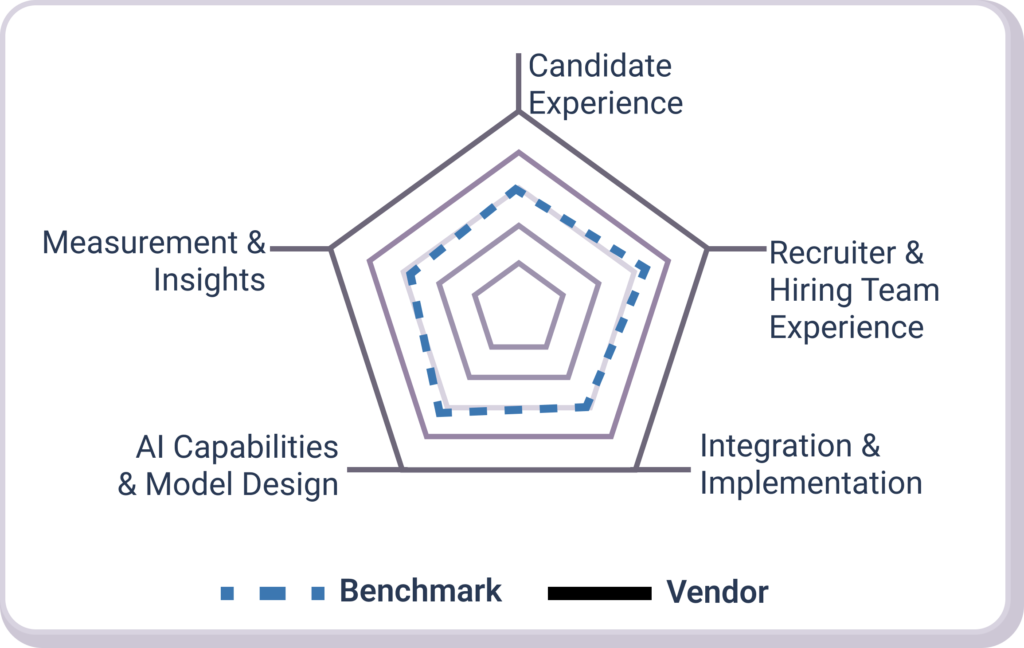
At the heart of the model is a radar-based view of performance across five capability areas. The point isn’t to reduce a solution to a single score—it’s to preserve the shape of capability, because in emerging categories, shape reveals tradeoffs.
For our AI Interviewer Category Compass, the five “bearings” are:
- Candidate Experience
- Recruiter & Hiring Team Experience
- AI Capabilities & Model Design
- Measurement & Insights
- Integration & Implementation
Each vendor’s offering is assessed across these areas using clear degrees of offering—from Not Offered to Robust Offering—based on what was shared, shown, and validated.
Understanding AI Interviewers: The Perfect Starting Point for the Category Compass
We launched the Category Compass with AI interviewers for a simple reason: this category needed it more than most.
AI interviewers represent a new layer of automation in some of the most judgment-heavy parts of hiring: how applicants are screened, how candidates are engaged, and how organizations determine who is most viable for a role.
That makes this category especially sensitive—not only because of what it can automate, but because of what it can inadvertently amplify if the hiring process is immature: inconsistent interview design, unclear criteria, weak governance, and brittle workflows.
As Emily Wares, Head of Solutions Consulting & Advisory at Kyle & Co and one of the leads on this evaluation, put it:
“AI can help surface patterns, but humans still need to recognize potential. Recruiters cannot simply act as a bottleneck and call it ‘human-in-the-loop.’ The real work is helping teams understand when—and why—to break the rules that machines are designed to follow.”
What’s Changing for Buyers, and What’s Next?
If there’s one mindset shift I’d encourage as you evaluate AI interviewers (and any fast-emerging category), it’s this: Instead of asking, “Who’s the leader in AI Interviewing?” try these questions instead:
- What problem are we trying to solve right now?
- Where does this fit in our hiring workflow?
- What level of consistency, transparency, and governance do we actually need?
- What will adoption look like six months after go-live?
- What process maturity is required for this to scale effectively?
Because the uncomfortable truth is that there is no universally “best” AI interviewer. Success depends on alignment—between use case and capability, between automation and maturity, and between innovation and governance.
In the coming weeks, we’ll be publishing our first-ever Category Compass research report focused on AI Interviewers. It will include:
- A clearer definition of what an AI interviewer is—and isn’t
- The five capability areas that matter most in practice
- What’s becoming table stakes versus what’s truly differentiated
- Profiles of landmark solutions shaping where this market goes next
- The key risks and constraints teams are encountering as pilots move toward scale
The goal isn’t to slow innovation down.
It’s to help talent leaders engage earlier and more deliberately—with clearer expectations, better questions, and a much better map.
The suspense is killing me